 MACH//BREAK
Roadmap
Phases, not dates
The order of construction is a design law: movement, networking, weapon feel, BreakFlag, maps, roles, vehicles, matchmaking, new-player experience, progression, cosmetics, lore, modes, guild warfare. Each phase has an exit test, and a phase is done when the test passes, not when a calendar says so. Some later-phase things exist early (six maps, a launcher, a backend, a scout); that is inventory, not phase progress, and this page does not count it as such.
-
Phase 0 · Movement LabDone
One map, one frame, jets, Glide, energy, a speedometer. Exit test: players enjoy moving without weapons. Passed, with a regression suite behind the numbers: slope momentum preservation, Burn Arc timing, speed bands per frame.
-
Phase 1 · Combat LabDone
Impulse Launcher, Vector Cannon, health, respawn, basic multiplayer with server authority, client prediction and lag compensation. Exit test: small team sessions are fun and stable. Passed on a LAN and over the internet at the latencies we benchmark against.
-
Phase 2 · Core PrototypeContent complete · exit test pending
BreakFlag with two bases, three frames, weapons, deployables and 8v8 with bots filling the seats. Exit test: an internal 8-a-side session with humans produces real tactics, and testers keep playing after the session ends. Done so far: BreakFlag with the 60-second return clock, the standoff rule and a cap limit of five; three frames, the Bulwark with four production bodies; thirteen weapons, six packs, eleven deployables; base guns, radar, generators and inventory stations on every base, with the power rule; six maps; bots with seven roles that plant, raid and defend; a hover scout; a deterministic 32 ms server simulation with client prediction and lag compensation; replays hashed and verified by about 310 automated suites on every release; a Windows launcher with Live and test-realm channels; accounts, a server browser and match stats. Not done: the exit test itself. The records hold no match with more than one human in it, and that session is the next milestone.
-
Phase 3 · Vertical SliceNext · materials exist
One polished map with art, sound and UI; the first strategy systems (sensors, beacons, jammers, cloak, aim painting, repair, power) so multi-stage plays can emerge; first vehicles; a progression prototype; matchmaking. Honest state: the strategy materials are all in the build and tested, but the multi-stage chain is not yet one system with its own telemetry; six maps, a launcher, a backend and one hover scout exist ahead of their phase; vehicles are the next big push after the Phase 2 exit test, with the bots taught to use them and to counter them. Exit test: a public trailer or investor build is possible without lying.
-
Phase 4 · Closed AlphaLater
BreakFlag, Frontline and Vector Arena; Movement Trials; guilds; account-wide stats; anti-cheat; a public server browser. Exit test: community feedback validates the core loop.
-
Phase 5 · Early AccessLater
Progression, cosmetics, stats, servers at scale. Exit test: a sustainable live product. Business model to be decided before this point: free-to-play or premium.
-
Phase 6 · 1.0Later
Ranked and tournaments, guild warfare over the territory map, replay and observer tooling, UGC. Exit test: a full competitive ecosystem.
Right now
pre-alpha · internal build · friends and family
Core Prototype, content complete. A playable internal build runs on two channels, Live and a public test realm, for friends and family through a Windows launcher; the test realm just moved to the build with the Bulwark's production bodies, and rotates the icefield and Proving Ground. Playtests stay friends-only until the 8-a-side exit test passes. The dev log is generated from the dev notes and the experiment records and is the most precise status there is.
- Dev notes · 2026-10-20PTR, October 23 — the rules of the game, and the gun that fires where you point it
- Dev notes · 2026-10-19PTR, October 19 — the light that never cast, the base, the scoreboard and the bots as the reference's
- EXP-39 · 2026-10-18bot_aim_check static hit-rate is FOUND until MAC-612 (MAC-528 muzzle spread) — CLOSED 2026-10-18
- EXP-37 · 2026-10-17OWNER RULING · BreakFlag stalemate carrier reveal stays unbuilt until week 10 — RE-SCOPED 2026-10-20
Last updated 2026-10-25.
What we will not promise
Release dates, a price, platforms beyond Windows and Linux dedicated servers, vehicle counts, mode counts. Consoles come later and cross-play is designed in from the start; that is the extent of the platform promise.
Direction
First, make the loop complete. The classic team capture loop, finished and consistent, so that it plays like a finished thing: every base defended the same way, every spawn with the same kit, every rule the same on every map. That is what the build is today, and the exit test is the proof that it holds with humans in it.
Then change one element at a time. A weapon, a movement rule, a map, one at a time, with the build kept playable between changes, so each change can be judged on its own. Balance is tuned from play, not from spreadsheets.
Vehicles are the next big push. One hover scout proves the layer; the rest follows after the exit test, and the bots are taught to use vehicles and to counter them as part of the same work, so a bot match with vehicles is still a real match.
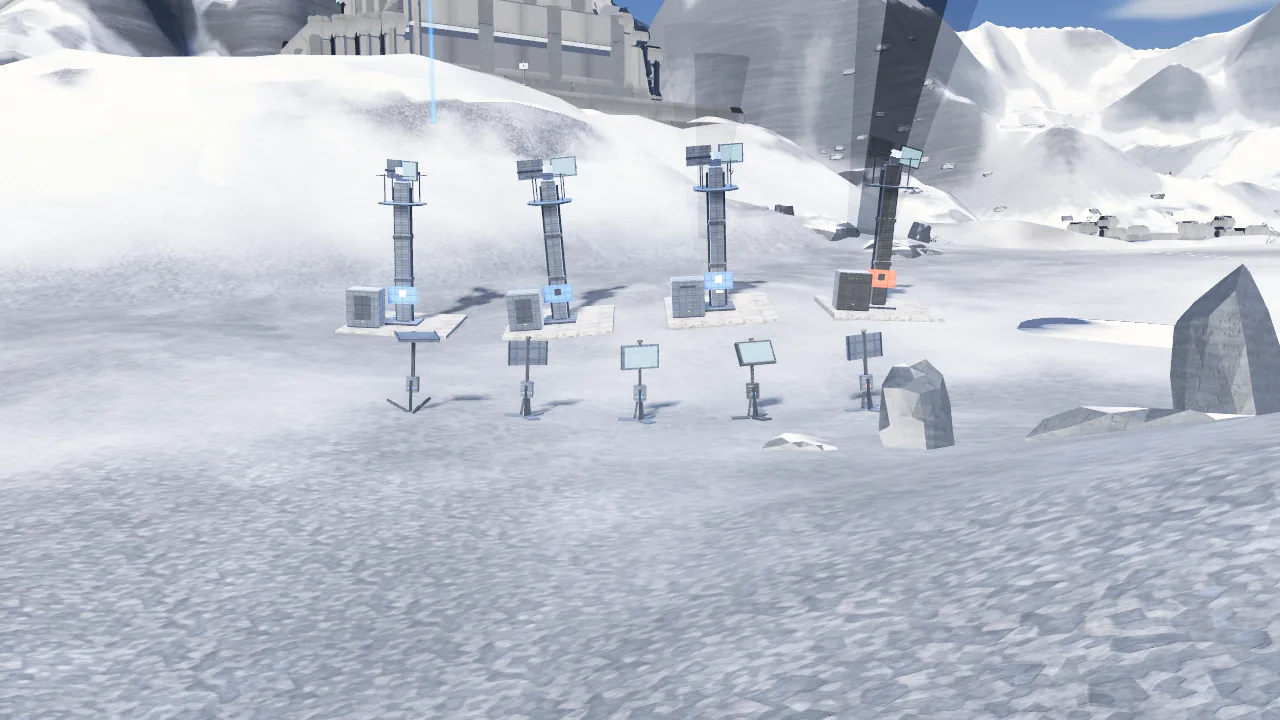
Where the look is going. The Bulwark's production bodies are on the test realm now, and the Strider and Ranger are next for the same treatment. Physics and latency came first, and the screenshots on this site show exactly where the look is, not where it will be.
How a phase gets done
Experiments
Every consequential change is an experiment: hypothesis, implementation, telemetry, result, keep or remove. Recorded, and published on the dev log.
Acceptance tests
About 310 automated suites run on every release: movement regression, replay determinism, wire fuzzing, bot matches on every map, screenshot gates for readability. Networking is benchmarked at 20, 50, 100 and 150 ms with loss and jitter.
One question
Every planning conversation asks: is this making movement more interesting? If not, why are we building it?